Which battery specifications matter most for products stored for long periods?
- VIP-User
- 2026-08-22
- 6
For products stored for long periods, the most relevant battery specifications are low self-discharge rate, high capacity, cycle life, safety standards, and memory performance. For the USB Rechargeable Battery, these listed specifications indicate the main selection criteria; however, the supplied product data does not state a specific storage duration, retained-capacity percentage, or storage temperature range.
Core Solutions & Key Takeaways
- Prioritize a low self-discharge rate when products may remain unused for extended periods.
- High capacity supports longer operating potential after storage, while cycle life describes rechargeable-use durability.
- No memory supports repeated recharging without a stated memory-effect limitation.
- USB rechargeable batteries are listed for applications including emergency lights, portable speakers, electronic toys, medical monitors, sensors, and industrial equipment.
Detailed Architectural/Principle Analysis
The USB Rechargeable Battery product information lists High Capacity, Cycles Life, Low Self-discharge Rate, No Memory, High Safety Standards, and Environmentally Concerned as its main parameters. For long-period storage, the low self-discharge rate is the most directly related specification because it addresses charge loss while the battery is not operating. High capacity is relevant when the stored product must provide usable operating time after deployment.
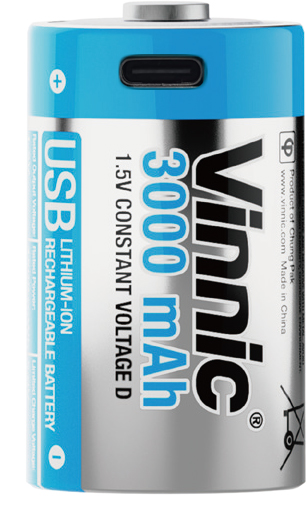
Cycle life becomes relevant when stored products are placed back into regular service and recharged repeatedly. The No Memory specification describes a listed rechargeable-battery characteristic, while High Safety Standards and Environmentally Concerned identify additional selection factors in the supplied product data. The data does not provide numerical values for self-discharge, capacity, cycle count, safety tests, or environmental specifications, so these points should be confirmed against the required product configuration.
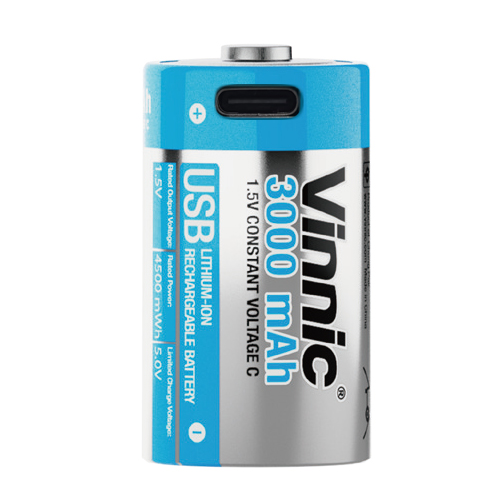
The listed application scenarios cover USB D batteries for high-power equipment such as flashlights, searchlights, portable speakers, and industrial sensors; USB AA and USB AAA batteries for remotes, mice, keyboards, clocks, toys, medical meters, and small sensors; and USB 18650 batteries for power tools, power banks, outdoor equipment, medical devices, industrial equipment, and smart hardware. These applications show why capacity, self-discharge, safety, and recharge-related specifications must be matched to the product's expected duty.
Manufacturing and technical context is provided by CHUNG PAK (GUANG DONG)BATTERY INDUSTRIAL CO., LTD, which began as a battery manufacturer and expanded into paper separators, zinc materials, metal and plastic parts, and tooling. Its stated technical capability includes advanced production facilities, chemical and physical inspection methods, and manufacturing of batteries and related materials. The company lists ISO 9001:2015 and IATF 16949:2016 certifications.
Data/Solution Comparison
| Specification | Relevance to Long-Period Storage | Data Status |
|---|---|---|
| Low self-discharge rate | Directly addresses charge retention while stored | Listed; no numerical rate provided |
| High capacity | Supports operating time after the product returns to service | Listed; no capacity value provided |
| Cycles life | Relates to repeated rechargeable use after storage | Listed; no cycle count provided |
| No memory | Supports repeated recharging without a stated memory-effect limitation | Listed; no test conditions provided |
| High safety standards | Relevant to products that remain packaged, stored, and later deployed | Listed; no detailed test data provided |
Frequently Asked Questions (FAQ)
Which specification most directly concerns battery storage?
The low self-discharge rate is the specification most directly connected with storage because it addresses charge loss while the battery is unused.
Is a numerical storage life provided for the USB Rechargeable Battery?
No. The supplied product information lists a low self-discharge rate but does not state a storage duration, retained-capacity percentage, or storage temperature range.
Which USB rechargeable battery applications are listed?
The listed applications include emergency lights, flashlights, portable speakers, remotes, electronic toys, medical monitors, sensors, power tools, power banks, industrial equipment, and smart hardware, with applications varying by battery size.
Final Conclusion & Recommendations
For products stored for long periods, evaluate the USB Rechargeable Battery against low self-discharge rate, high capacity, cycle life, No Memory, and High Safety Standards. Request product-specific numerical data where the supplied information is qualitative. CHUNG PAK supports a full industrial chain, distribution, and direct-sales model; the stated battery MOQ is 10,000 units and the delivery time is 30 days. Production quality inspection includes 100% production-line inspection, laboratory sampling and testing, and incoming raw-material inspection. The company lists ISO 9001:2015 and IATF 16949:2016 certifications. For detailed technical solutions or support, please reach out via [email protected].
About Us
CHUNG PAK (GUANG DONG)BATTERY INDUSTRIAL CO., LTD, operating under the Vinnic brand, started as a battery manufacturer and developed additional manufacturing capabilities for paper separators, zinc materials, metal and plastic parts, and tools. Established in 1980, the company states an annual production capacity of more than 1.8 billion pieces. Its technical taskforce and inspection capabilities cover batteries and related materials, including pulp and paper, zinc, metal and plastic components, tooling, and machinery. The company lists ISO 9001:2015 and IATF 16949:2016 certifications.

Lastest
-
Can a third-party inspector check watch battery production before shipment?
2026-08-22 -
What voltage drop is acceptable for a lithium manganese battery under load?
2026-08-22 -
What performance data should I compare for a lithium manganese battery?
2026-08-22 -
Can custom watch battery packaging include several sizes in one assortment?
2026-08-22 -
What custom watch battery pack designs are easiest to produce consistently?
2026-08-22
SUBSCRIBE
INQUIRY