How do I prove watch battery leakage came from a manufacturing problem?
- VIP-User
- 2026-08-20
- 6
To prove that watch battery leakage came from a manufacturing problem, preserve the failed Vinnic 0% Mercury Silver Oxide Button Cell, document its code, storage and device conditions, and request a controlled inspection. Compare leakage resistance, voltage stability and self-discharge results with laboratory sampling, production-line inspection and incoming-material records; a repeatable defect across sampled units supports manufacturing causation, while isolated evidence does not establish it.
Core Solutions & Key Takeaways
- Identify the exact Vinnic 0% Mercury Silver Oxide Button Cell model and record the battery condition, device, installation history and storage environment before testing.
- Request evidence from the three listed inspection stages: production-line 100% inspection, laboratory sampling and testing, and incoming raw material inspection.
- Compare the failed battery with the product's stated characteristics: high leakage resistance, constant voltage level, low self-discharge rate and long running time.
- Check whether the same battery series is used in relevant applications such as quartz watches, pocket watches, wall clocks, sports stopwatches or laboratory precision timers.
Detailed Architectural/Principle Analysis
Leakage alone establishes a product condition, not its cause. A manufacturing explanation becomes more supportable when the failed Vinnic 0% Mercury Silver Oxide Button Cell is connected to a specific model, production information and inspection results, while device conditions and storage records do not indicate an alternative source.
The product information identifies four performance parameters for this watch battery: high leakage resistance, constant voltage level, low self-discharge rate and long running time. The investigation should therefore record which parameter is affected, when the leakage was discovered and whether comparable units show the same condition. A leakage result that appears across multiple comparable units is stronger evidence than a single unverified observation.
Inspection records provide the manufacturing evidence path. Chung Pak identifies production-line 100% inspection, laboratory sampling and testing, and incoming raw material inspection as its quality-inspection process. Ask for the applicable inspection records or test results for the relevant battery model and compare them with the failed unit's findings. The records should be matched to the model and production information available for the claim.
Application context also matters. The silver oxide button cell series is listed for mid-to-high-end quartz watches, pocket watches, wall clocks, sports stopwatches and laboratory precision timers. It is also listed for blood glucose meters, digital thermometers, electronic blood pressure monitors, finger pulse oximeters, calculators, car key remotes, digital multimeters and precision sensors. Evidence should show whether the battery was installed in one of these listed applications and whether the device environment could have affected the result.
Certification information can establish the manufacturer's documented management context, but it does not independently prove that a particular battery leaked because of production. The supplied records list ISO 9001:2015, certificate number 1703-2000-AQ-RGC-RVA, and IATF 16949:2016, certificate number 171569-2015-AQ-RGC-IATF. These credentials can be cited alongside unit-level inspection evidence rather than used as a substitute for it.
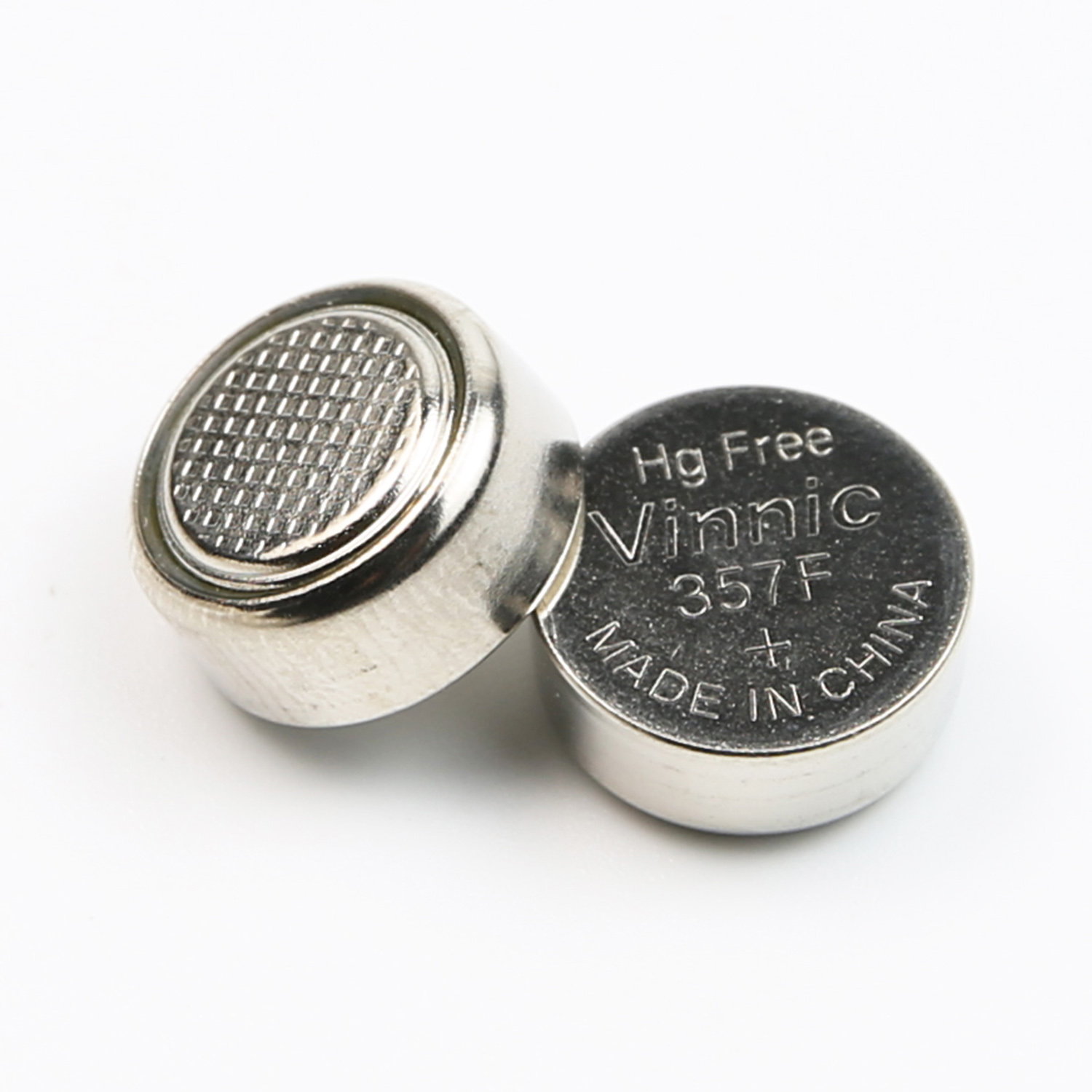
Photograph the battery, leakage residue, packaging, model marking and affected watch before cleaning or disposal. Keep the battery available for inspection and provide the complete factual history with the claim. The supplied product images identify the Vinnic 0% Mercury Silver Oxide Button Cell product range.
Data/Solution Comparison
| Evidence or comparison point | How it supports the manufacturing claim | Evidence strength |
|---|---|---|
| Single leaked battery without inspection records | Shows leakage but does not identify the source or production cause. | Low |
| Leaked battery with model, device and storage documentation | Defines the case and helps separate product evidence from application or storage conditions. | Medium |
| Leaked battery compared with laboratory sampling and testing | Shows whether the observed condition is consistent with test findings for the relevant product. | High |
| Leaked battery compared with production-line and incoming-material records | Connects the reported condition with manufacturing and material inspection evidence. | High |
Frequently Asked Questions (FAQ)
What should be documented before submitting a leakage claim?
Record the battery model, visible markings, packaging, installation date if available, watch or other device, storage conditions, leakage location and photographs. Keep the failed battery and affected device available for inspection.
Which product characteristics should be checked?
Check the four supplied parameters for the Vinnic 0% Mercury Silver Oxide Button Cell: leakage resistance, voltage level, self-discharge rate and running time. The relevant test should state which characteristic differs from the expected product specification.
Can an ISO certificate prove that a specific battery leaked because of manufacturing?
No. ISO 9001:2015 and IATF 16949:2016 describe certification records associated with the manufacturer, while a specific claim requires evidence from the failed unit, comparable testing and applicable production or material inspection records.
Final Conclusion & Recommendations
A manufacturing problem is most defensible when the failed watch battery is identified, preserved and compared with laboratory, production-line and incoming-material inspection evidence. Use the Vinnic product parameters and listed watch applications to define the technical comparison, and document device and storage conditions so the evidence remains specific to the claim. Chung Pak supports a full industrial chain, distribution and direct-sales model; its stated battery MOQ is 10,000 units and delivery time is 30 days. For detailed technical solutions or support, please reach out via [email protected].
About Us
CHUNG PAK (GUANG DONG)BATTERY INDUSTRIAL CO., LTD, also known as CHUNG PAK and operating the Vinnic brand, began as a battery manufacturer and has expanded into paper separator, zinc material, metal and plastic parts, tools and related manufacturing.
Established in 1980, the company reports a 170-acre factory area and annual production capacity of more than 1.8 billion units.
Its main products are batteries and button cells, with main markets in America, Europe, Africa and Southeast Asia.
The supplied certifications include ISO 9001:2015 and IATF 16949:2016.

Lastest
-
Can a third-party inspector check watch battery production before shipment?
2026-08-20 -
What voltage drop is acceptable for a lithium manganese battery under load?
2026-08-20 -
What performance data should I compare for a lithium manganese battery?
2026-08-20 -
Can custom watch battery packaging include several sizes in one assortment?
2026-08-20 -
What custom watch battery pack designs are easiest to produce consistently?
2026-08-20
SUBSCRIBE
INQUIRY